
When Your Body and Your Life Are Both Falling Apart at the Same Time
Mar 29, 2026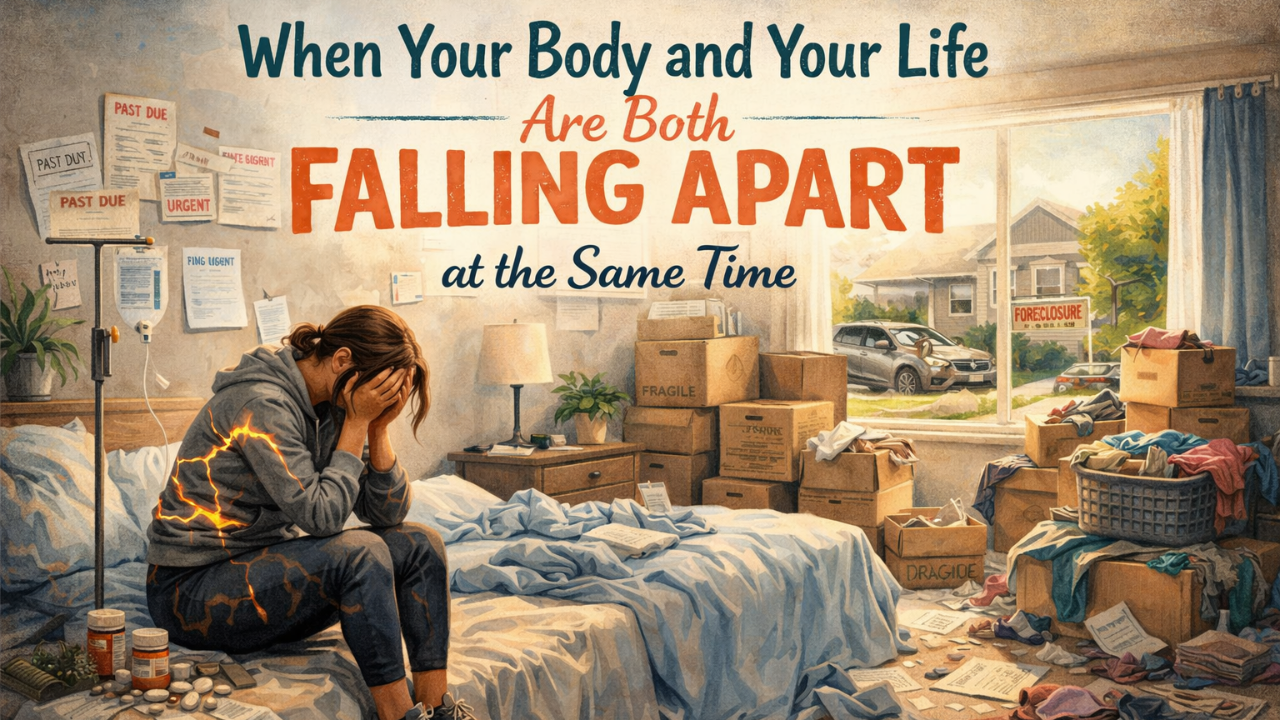
MIDLIFE CHANGE • IDENTITY • SELF-TRUST
A gentle, honest conversation for the introverted woman navigating perimenopause and divorce — and wondering why no one told her it could feel like this.
By Reclaim Your Calm | 10 min read | Wellness · Midlife · Emotional Health
There's a particular kind of exhaustion that doesn't show up on any lab test.
It's the exhaustion of waking up at 3 a.m. drenched in sweat, heart racing, mind already spinning through the legal paperwork sitting on your kitchen table. It's the exhaustion of holding yourself together at work — answering emails, sitting through meetings — while inside you're quietly grieving a marriage, a version of yourself, a future you thought was already settled.
If you're somewhere in that space right now, I want you to take a slow breath. Not because a deep breath fixes anything — it doesn't — but because you deserve at least one moment today where someone says to you: You are not falling apart. You are carrying too much. There is a difference.
This article is for the woman who is simultaneously going through perimenopause and a divorce or major separation — and who has spent months, maybe years, trying to manage both largely on her own. Quietly. Professionally. Without making too much of a fuss.

The Collision Nobody Talks About
Most of the content you find about perimenopause is written as if it happens in a vacuum — as if the woman going through it has a calm home, a stable partnership, plenty of sleep, and the luxury of focusing on her hormones.
And most of the content written about divorce assumes a woman whose primary challenge is the legal or financial logistics — not someone who is simultaneously forgetting words mid-sentence, crying without warning, and lying awake wondering if the anxiety is grief, or hormones, or both.
But for a growing number of women — particularly professional, introverted women in their 40s and early 50s — these two experiences are happening at exactly the same time. And that collision creates something that is genuinely unlike either experience alone.
Here's what I mean. Perimenopause — the years leading up to the end of your menstrual cycle, which can begin as early as your late 30s — involves real, measurable neurological and hormonal shifts. Declining estrogen and progesterone affect the parts of the brain that regulate mood, stress response, memory, and sleep. This is not you being dramatic. This is biology.
Divorce, meanwhile, is classified by researchers as one of the most acutely stressful life events a person can experience — second only to the death of a spouse on the Holmes-Rahe Stress Scale. It triggers the same neurochemistry as grief. It rewires your sense of identity. It forces decisions about finances, housing, children, and the future while you're least equipped to make them.
When these two experiences overlap, the nervous system doesn't just get stressed — it gets overloaded. The brain's threat-detection system, the amygdala, goes into near-constant activation. And for an introverted woman, who already requires more recovery time from stimulation and emotional labour, this kind of sustained overload doesn't just feel hard. It feels like a fundamental loss of self.
"Am I Going Crazy, or Is Something Actually Wrong?"
One of the most common things I hear from women in this season is some version of: I feel like I don't know myself anymore. I'm forgetting things. I can't think straight. I used to be so capable. What is happening to me?
I want to answer that question directly, because I think you deserve a real answer instead of a reassuring deflection.
Something is happening to you. Several things, in fact. And they are all real, and they are all connected, and none of them mean you're going crazy.
What you may be experiencing:
- Brain fog and word-finding difficulty — a documented symptom of fluctuating estrogen levels, which directly affect verbal memory and processing speed.
- Heightened emotional reactivity — progesterone has a calming effect on the nervous system; as it declines, you lose some of that natural buffer against stress and emotional intensity.
- Disrupted sleep — night sweats, racing thoughts, and early waking are all connected to hormonal changes that affect the sleep-wake cycle, and chronic sleep deprivation compounds every other symptom.
- Increased anxiety — the stress hormones cortisol and adrenaline, already elevated from the psychological trauma of divorce, interact with perimenopause in ways that amplify anxiety significantly.
- Grief that feels disproportionate — because it isn't disproportionate. You're not only grieving a relationship; you may be grieving your previous identity, your sense of safety, and, quietly, the version of midlife you thought you were going to have.
This is not weakness. This is a nervous system under enormous pressure, doing exactly what nervous systems do.
"I kept thinking I just needed to get through the next thing. The next court date, the next difficult conversation, the next week. But 'the next thing' never stopped coming. And I was running on empty long before I admitted it to myself."
— A composite from many conversations with women navigating this season

The Hidden Weight of Being "The Strong One"
Here's something I've noticed, and I think it matters: the women who tend to struggle most silently in this season are often the most competent ones.
They're the ones who kept their jobs, kept showing up for their kids, kept responding to emails, kept being the person other people leaned on — even while their world was restructuring itself around them. They are, by most external measures, doing fine. Functioning. Managing.
But functioning is not the same as healing. And managing is not the same as being okay.
For introverted women especially, there's an enormous cost to the performance of capability. Every interaction that requires emotional output — every difficult conversation with an ex, every "I'm fine" at work, every time you hold back tears in a public space — is a withdrawal from an energy reserve that is already depleted.
And then there's the self-blame. Oh, the self-blame.
I should have seen it coming. I should have handled this better. Why am I still so affected by this? Why can't I just move on? Other people manage far worse. What is wrong with me?
If any version of that inner monologue sounds familiar, I want to offer you this gently but clearly: self-blame is not the same as accountability, and it is not helping you heal. It is, in fact, adding an additional layer of stress to a nervous system that is already overloaded.
What you're experiencing doesn't need your judgment. It needs your attention, your gentleness, and — when you're ready — some real, grounded support.
What Regulation Actually Looks Like When You're an Introvert in Crisis
I want to talk about nervous system regulation, but I want to do it in a way that doesn't sound like a wellness cliché — because you've probably been told to breathe deeply, journal your feelings, and do yoga, and if that alone were enough, you wouldn't still be reading this.
Regulation, at its core, is about helping your nervous system understand that it is safe — even temporarily, even imperfectly — so that it can come out of threat mode long enough for you to think, feel, and function more clearly.
For women who are introverted, this process has some specific characteristics worth understanding.
Solitude is not avoidance — it's medicine.
In a culture that often pathologizes being alone, it's worth naming this clearly: introverts genuinely restore through quiet and solitude. If your nervous system craves silence right now, that is not withdrawal. That is a legitimate biological and psychological need. Protect it.
Boundaries are not walls — they are the conditions under which you can heal.
One of the most depleting dynamics in a high-conflict or emotionally taxing divorce is the continued exposure to people and interactions that keep pulling you back into threat mode. Learning to create and hold boundaries — clearly, calmly, without guilt — is not a luxury skill in this season. It is a survival skill. And it can be learned, even when it feels impossible right now.
Regulation comes before motivation.
If you're waiting until you feel motivated to take care of yourself, you may wait a long time. A dysregulated nervous system does not produce motivation — it produces inertia. The path forward is not to will yourself into action, but to gently, incrementally reduce the load on your nervous system until action becomes possible again.

Reclaiming Self-Trust When You Don't Know Which Way Is Up
One of the quietest, most devastating losses in this season is the loss of trust in yourself.
When your body is behaving unpredictably, when your emotions don't feel like yours, when a decision you made — a marriage, perhaps — turned out not to look the way you thought it would, it is genuinely difficult to trust your own instincts. Your own perceptions. Your own judgment.
But here's what I want you to consider: the fact that you're questioning yourself so deeply right now is not evidence that your instincts are broken. It may be evidence that you've spent a long time overriding them.
Self-trust doesn't come back all at once. It comes back in small moments of keeping promises to yourself. Of noticing what you actually need, instead of what you think you should need. Of making one small decision that honors your own knowing — and seeing that you were right.
It is a practice. A quiet, daily, deeply personal practice. And it is possible — even here, even now, even when everything else feels uncertain.
Questions I Hear Often (And Honest Answers)
Can perimenopause and divorce really make anxiety worse?
Yes — and not just a little. Perimenopause already affects the brain's stress-response systems through hormonal changes. Divorce adds a significant, ongoing psychological stressor. Together, they can create a cycle of anxiety and sleep disruption that is very difficult to break without intentional support. This is a physiological reality, not a personal failing.
How do I know if I'm depressed or just exhausted?
This is an important question, and one worth discussing with a medical professional — because both are possible and both deserve attention. What I will say is this: the kind of bone-deep exhaustion that comes from sustained stress and poor sleep can look and feel a great deal like depression. Getting quality support — whether from a doctor, a therapist, or a structured wellness program — matters for both.
Is it normal to feel like I've lost my identity?
Completely normal — and deeply painful. Major life transitions, particularly the end of a long relationship, require a reconstruction of identity. When that coincides with the hormonal and neurological shifts of perimenopause, the sense of self can feel very fragile. This is not a permanent state. It is a passage. And navigating it with the right support makes an enormous difference.
FREE GUIDE
Are you carrying more than you realize?
Download the free guide: "5 Signs You're Carrying More Than You Think" — a gentle, honest resource for the woman who keeps saying she's fine, but suspects she isn't.
You Don't Have to Have It All Together to Begin
I want to close with something I wish someone had said to me sooner: you don't have to be okay to take the first step toward okay.
You don't need to have processed the grief. You don't need to have figured out your hormones. You don't need to have stopped crying in the car or started sleeping through the night. You don't have to have a plan.
What you need, right now, is probably just one thing: someone to tell you that what you're experiencing is real, it's a lot, and you don't have to white-knuckle your way through it alone.
So: what you're experiencing is real. It's a lot. And you don't have to white-knuckle your way through it alone.
When you're ready — not before, but when — I'd love to be a part of what comes next.
With warmth,
Tracy